
Now when Jesus heard that John had been arrested, he withdrew to Galilee. He left Nazareth and made his home in Capernaum by the sea, in the territory of Zebulun and Naphtali, so that what had been spoken through the prophet Isaiah might be fulfilled:
“Land of Zebulun, land of Naphtali,
on the road by the sea, across the Jordan, Galilee of the Gentiles—
the people who sat in darkness
have seen a great light,
and for those who sat in the region and shadow of death
light has dawned.”
From that time Jesus began to proclaim, “Repent, for the kingdom of heaven has come near.”
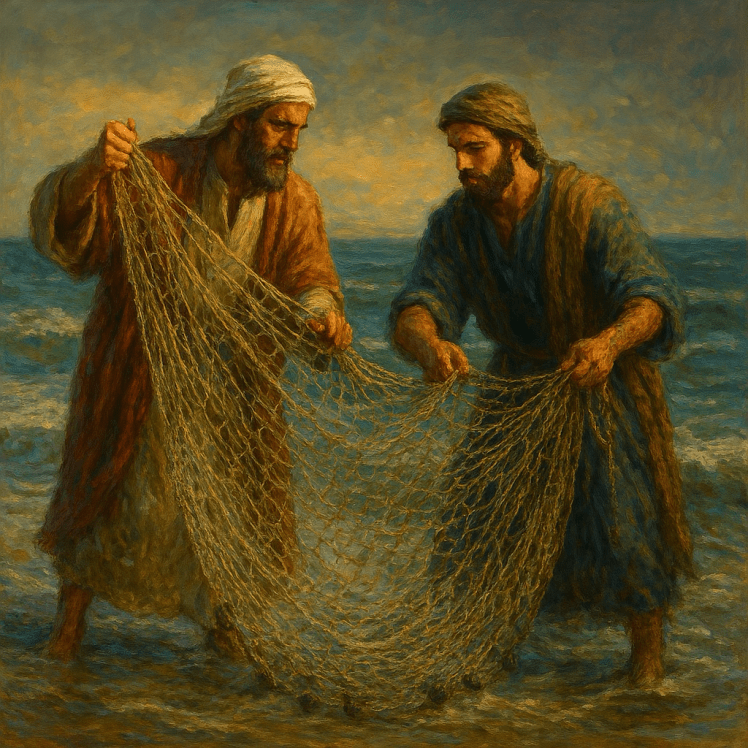
As he walked by the Sea of Galilee, he saw two brothers, Simon, who is called Peter, and Andrew his brother, casting a net into the sea—for they were fishermen. And he said to them, “Follow me, and I will make you fish for people.” Immediately they left their nets and followed him. As he went from there, he saw two other brothers, James son of Zebedee and his brother John, in the boat with their father Zebedee, mending their nets, and he called them. Immediately they left the boat and their father, and followed him.
Jesus went throughout Galilee, teaching in their synagogues and proclaiming the good news of the kingdom and curing every disease and every sickness among the people. (NRSV)
Reflection
When I was a young fella, I used to go outside every day to play with my mates. There were no mobile phones, the internet, or online gaming. Around lunchtime and dinner, the neighbourhood would fill with the sounds of us kids being called home. You knew the call meant something important – like food – and you dropped everything and came home immediately. Today, we hear about answering the call.
Today’s gospel from Matthew might perhaps be summarised as ordinary people and an extraordinary call.
Matthew notes that Jesus performs wonders, heals, and casts out demons. Yet these acts are secondary to Jesus’ role as an interpreter of the Scriptures and a teacher who pleases God. Disciples are called to follow the Messiah’s example, and Matthew offers guidance on how to do so—by committing to live in accordance with Jesus’ teachings.
Matthew tells us that after John the Baptist’s arrest, Jesus withdrew to Galilee. With that simple narrative shift, Matthew signals something far more significant: the public ministry of Jesus has begun.
Not in Jerusalem. Not at the Temple. Not among the religious authorities. But in Galilee of the Gentiles—on the margins, in a place associated with mixture, obscurity, and ordinary life. From the outset, Matthew wants us to see that God’s great work does not begin where we might expect.
Jesus’ ministry begins in the shadow of loss. John has been arrested; the prophetic voice crying out in the wilderness has been silenced. Yet God’s purposes are not threatened. They continue—indeed, they intensify. Matthew explicitly links this moment to Isaiah’s promise: “The people who sat in darkness have seen a great light.” The light dawns not because circumstances are favourable, but because God is faithful. Into a moment of uncertainty and fear, Jesus steps forward and proclaims: “Repent, for the kingdom of heaven has come near.”
This announcement frames what follows. Jesus is not offering moral improvement or spiritual techniques. He declares that God’s reign is breaking into ordinary time and space. The kingdom is near—not distant or abstract, but close enough to disrupt lives. Matthew immediately shows us how that disruption begins.
Jesus walks along the Sea of Galilee and sees two brothers, Simon Peter and Andrew, casting a net into the sea. They are fishermen—skilled, certainly, but unremarkable in the world’s eyes.
There is no hint that they are seeking a rabbi, longing for spiritual significance, or hoping for a change in their lives. They are doing what they have always done. Working. Providing. Living ordinary lives shaped by routine and responsibility.
Jesus speaks only a few words: “Follow me, and I will make you fish for people.” Matthew then tells us, in striking simplicity, “Immediately they left their nets and followed him.”
A little further on, the pattern repeats. James and John are with their father, Zebedee, mending their nets. Again, no preparation, no recorded conversation, no explanation. Jesus calls them. “Immediately they left the boat and their father and followed him.”
Matthew’s repeated use of the word “immediately” is deliberate. It is not merely descriptive; it is formative. Matthew wants his readers to grasp an essential truth about discipleship. Following Jesus demands decisiveness. It requires a willingness to respond when the call comes, without endless delay or negotiation.
Yet this immediacy can trouble us. We hear it and imagine recklessness, impulse, or naïveté. We wonder how these men could leave their livelihoods and families so quickly. But Matthew is not commending impulsiveness. He is pointing to recognition.
Here, the wisdom of St Benedict is helpful. The Rule opens with a summons that has shaped Christian spirituality for centuries: “Listen carefully, my child, to the master’s instructions, and attend to them with the ear of your heart.” Benedict understands that God’s call is rarely loud or coercive. It is not the voice that overwhelms, but the one that is recognised. The ear of the heart is formed over time—through attentiveness, faithfulness, and a life lived close enough to God to discern his voice when it speaks.
Perhaps this is what happens by the Sea of Galilee. Jesus does not argue or persuade. He does not raise his voice. He simply says, “Follow me.” And something in these men resonates. The call reaches beyond the ears. It touches the place where longing, readiness, and vocation already dwell. They hear with the ear of the heart.
This suggests that the disciples’ immediate response is not shallow but profound. Long before they leave their nets, God has been quietly at work within them. Their obedience is swift because it aligns with what God has already been stirring beneath the surface of their ordinary lives.
Here we encounter one of the great surprises in the Gospel. Jesus does not begin his ministry by calling the powerful, the educated, or the religiously accomplished.
He does not seek out those we might expect to be obvious candidates for leadership in God’s kingdom. He calls fishermen, then a tax collector. Ordinary men whose names would never have appeared on any list of likely disciples.
This is no accident. God does not call ordinary people despite their ordinariness, but through it. Their daily work—casting and mending nets—becomes the language of their calling. Jesus does not erase who they are; he reorients them. “I will make you fish for people.” What they already know becomes a vessel for what God will do through them.
Discipleship, then, is not about becoming extraordinary so that God might use us. It is about trusting that God delights in using ordinary people for extraordinary purposes. The kingdom advances not through impressive credentials but through faithful response.
Matthew goes on to show that discipleship is inseparable from participation in Jesus’ mission. Jesus travels throughout Galilee, teaching in synagogues, proclaiming the good news of the kingdom, and healing every disease and sickness among the people. The call to follow Jesus draws the disciples into this work—not because they are prepared, but because they are willing.
At this point, the disciples understand very little. They have no developed theology and no clear sense of where this path will lead. They simply follow. Discipleship begins not with mastery or certainty, but with trust and commitment.
This speaks directly to us. Many of us are acutely aware of our ordinariness. We know our limitations, hesitations, and unfinished faith. We assume God calls only the confident, the gifted, and the spiritually impressive. Matthew tells us otherwise. God calls people at work, in routine, amid ordinary responsibilities. God calls us not after we have perfected our lives, but within them.
And the call still comes quietly. It still requires the ear of the heart. It still invites a response that may feel costly yet is ultimately life-giving.
At the outset of Jesus’ ministry, Matthew shows us what the rest of the Gospel confirms: the light shines in unexpected places; the kingdom comes near ordinary people; and God entrusts his work to those willing to listen and follow.
May we learn to listen with the ear of the heart. When the call comes—gentle, persistent, unmistakable—may we, in our ordinary places, follow with trust, immediacy, and courage.
© Robert van Oort 2026
 Bob van Oort