
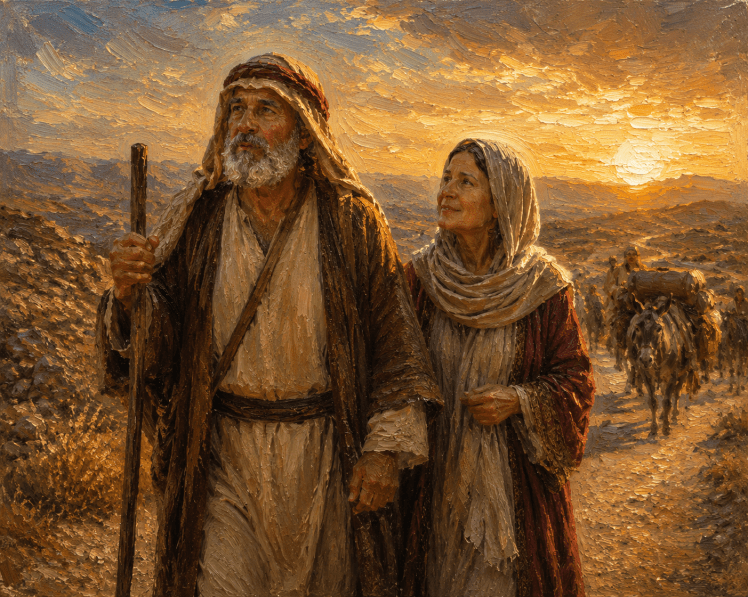
Now the LORD said to Abram, “Go from your country and your kindred and your father’s house to the land that I will show you. I will make of you a great nation, and I will bless you, and make your name great, so that you will be a blessing. I will bless those who bless you, and the one who curses you I will curse; and in you all the families of the earth shall be blessed.”
So Abram went, as the LORD had told him; and Lot went with him. Abram was seventy-five years old when he departed from Haran. Abram took his wife Sarai and his brother’s son Lot, and all the possessions that they had gathered, and the persons whom they had acquired in Haran; and they set forth to go to the land of Canaan. When they had come to the land of Canaan, Abram passed through the land to the place at Shechem, to the oak of Moreh. At that time the Canaanites were in the land. Then the LORD appeared to Abram, and said, “To your offspring I will give this land.” So he built there an altar to the LORD, who had appeared to him. From there he moved on to the hill country on the east of Bethel, and pitched his tent, with Bethel on the west and Ai on the east; and there he built an altar to the LORD and invoked the name of the LORD. And Abram journeyed on by stages toward the Negeb. (Genesis 12:1-9 NRSV)
Reflection
It is easy to think of the Bible as a collection of separate stories. For example, we read about Adam and Eve, Noah, Abraham, Moses, David, and, of course, Jesus. Yet the Bible is not merely a collection of stories; it is one great story. It is the story of God’s plan to save a fallen world.
The first three chapters of the Bible describe the wonder of God’s creation. But then everything goes wrong. Humanity turns away from its perfect relationship with God, and things deteriorate to the point that the Bible declares, “the wickedness of humankind was great in the earth, and that every inclination of the thoughts of their hearts was only evil continually” (Genesis 6:5). Yet God does not abandon us. God has a plan.
God’s plan begins to unfold in a remarkable way in Genesis 12. Here we meet Abram, living an ordinary life in Haran. Yet through this seemingly ordinary man, God would begin a work that would ultimately bring salvation to every nation on earth. This passage reveals God as the One who calls, the One who promises, and the One who saves.
The passage begins with a command from God: “The Lord had said to Abram, ‘Go from your country, your people and your father’s household to the land I will show you.’” At first glance, this may not seem extraordinary. People move from one place to another all the time. But this was no ordinary journey. God was calling Abram to leave everything that gave him security.
He was to leave his homeland, his extended family, and everything familiar to him. Even more striking, he was called to go without knowing exactly where he was heading. God did not hand Abram a map or outline every detail of the journey. He simply said, “Go to the land I will show you.”
That required faith. Faith is trusting God when we cannot see the whole picture. Faith is believing God’s word even when the future remains hidden from us.
Many of us wish God would reveal every detail before we take a step. We want to know where the road leads, what challenges lie ahead, and how everything will turn out. Yet God often works as he did with Abram, calling us to trust him first and understand later.
The remarkable thing is Abram’s response. Verse 4 says, “So Abram went, as the Lord had told him.” There is no argument, no delay, and no bargaining with God. Abram trusted God’s word and obeyed.
This is one of the great examples of faith in all of Scripture. Abram was not saved because he was perfect; he was saved because he trusted the God who called him. The same is true today. We are not saved by our achievements or our goodness. We are saved by faith in God’s promises—promises that find their fulfilment in Jesus Christ.
As important as God’s command is, the heart of this passage lies in God’s promises.
Listen again to what God says: “I will make you into a great nation, and I will bless you; I will make your name great, and you will be a blessing.” Then God adds these remarkable words: “All peoples on earth will be blessed through you.” These promises must have seemed astonishing to Abram. At this point, Abram was old, and he and Sarai had no children. Humanly speaking, the future looked uncertain. Yet God promised descendants, a nation, a land, and a blessing.
The repeated use of the phrase “I will” in this passage is striking. The future does not depend on Abram’s power; it depends on God’s faithfulness. This is a wonderful reminder for us. Our hope does not rest on our strength, our wisdom, or our abilities. Our hope rests on the promises of God.
But one promise rises above all the others: “All peoples on earth will be blessed through you.” These words reveal God’s heart for the world. Ever since Adam and Eve’s fall, humanity has lived under the shadow of sin. The world became filled with violence and rebellion. By the end of Genesis 11, we see humanity united at Babel in pride and defiance against God. Yet God had not abandoned his creation. Instead, he began a rescue mission. He chose Abram and promised that through him, blessing would come to all nations.
This promise points directly to Jesus Christ. The New Testament tells us that Jesus is the descendant of Abraham through whom God’s blessing comes to the world. Through his perfect life, atoning death on the cross, and victorious resurrection, salvation is offered to people from every tribe and nation.
When God called Abram, he was already preparing the way for Bethlehem, Calvary, and the empty tomb. This means the gospel did not begin in Matthew; the gospel story is already taking shape in Genesis. God’s plan of salvation was not an afterthought—it was his purpose from the very beginning.
What a comfort this should be for us. The God who worked patiently through the centuries to fulfil his promises is the same God who remains faithful today.
The story does not end with God’s blessing of Abram. God says something more. He blesses Abram so that the blessing might flow through him to others. This has always been God’s way. God’s people are never meant to be reservoirs that simply hoard blessings for themselves; they are meant to be channels through which God’s grace flows to others.
Wherever Abram went, he worshipped God and bore witness to him. Likewise, God calls his people today to bear witness to Christ. The church exists not merely for itself but for God’s mission in the world. We have received forgiveness so that we might proclaim it. We have received grace so that we might show it. We have received the good news so that we might share it.
The promise made to Abram continues to bear fruit whenever the gospel is preached and people come to faith in Jesus Christ. Today, millions of believers across every continent trace their spiritual heritage back to the promise God made to Abram. The blessing has reached the nations exactly as God promised.
As we conclude, let us remember that God calls us to trust him. Like Abram, we are called to walk by faith, not by sight. God keeps his promises. He has fulfilled what he promised Abram in Jesus Christ. Every promise of salvation finds its “Yes” in him.
God invites us to participate in his mission. We have been blessed so that we might be a blessing to others. Genesis 12 marks the start of a journey that ultimately leads to Jesus Christ. The God who called Abram is the same God who sent his Son into the world to save sinners. Today, that same God still calls people to himself. He calls us to trust him and to follow him. Through Jesus Christ, he offers forgiveness, reconciliation, and eternal life.
© Robert van Oort 2026

