
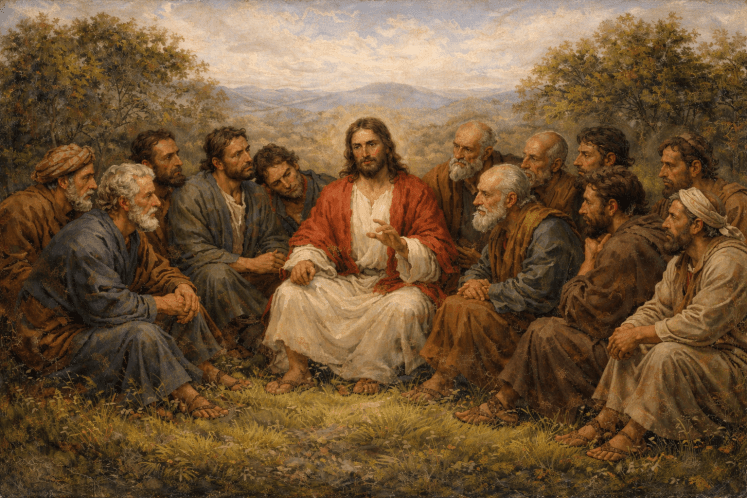
Jesus went on with his disciples to the villages of Caesarea Philippi; and on the way he asked his disciples, “Who do people say that I am?” And they answered him, “John the Baptist; and others, Elijah; and still others, one of the prophets.” He asked them, “But who do you say that I am?” Peter answered him, “You are the Messiah.” (Mark 8:27-29 NRSV)
Reflection
One sunny afternoon, Jesus sat with his disciples near the villages of Caesarea Philippi. He had decided it was time to move on to the next stage of his mission, but he wondered whether the disciples were ready. So he turned to them and said, “Hey, fellas, who do people say I am?”
They looked at each other with slightly confused expressions. Then the disciples answered, “Some say you are John the Baptist, returned from the dead; others say Elijah or one of the prophets.”
Jesus replied, “Yeah, yeah, I know all that. But that’s not what I am asking you. I want to know who you say I am?”
Utter silence. Indeed, this must be the start of another of those confusing parables.
After a long pause, Peter stood up and, with not just a little pride, proclaimed, “Thou art the Logos, existing in the Father as a quality of being on or by reason or logic, by an act of his will, being generated, in consideration of the various functions by which God is related to his creation, but only on the fact that we understand there is a Father, and a Son, and a Holy Spirit, each member being a Trinity coequal with every other member, and each acting inseparably with and interpenetrating every other member, with only an economic subordination within God, but causing no division which would make the substance no longer simple.”
Jesus scratched his ear thoughtfully, raised an eyebrow, and said, “How often do we make things seem more complicated than they need to be?”
This passage marks a turning point and an uncomplicated moment of truth for the apostles.
Until now, there’s been a lot of material prompting us to ask, “Who is this man Jesus?” Mark now cleverly challenges his readers to answer. Peter utters the gospel’s simplest and most critical four words: “You are the Christ.”
What Peter had to say in this passage was simple yet significant. By that, I mean it was a tangible, uncomplicated expression of faith. It cut to the essence of faith.
In Mark’s gospel, Jesus gets straight to the point. “Who do people say that I am?” and then, “But who do you say that I am?” Jesus was not looking for an elaborate doctrinal explanation or a silly answer in interpretative dance. He wanted them to express what was true in their hearts. Jesus wants no less from us today.
We need to examine our own answer to Jesus’ question. Is he simply a great teacher? Would we prefer him as a power figure, able to zap all the world’s problems into shape? Are we only prepared to say what is uncontroversial and agreeable to today’s culture? Or would we instead remain silent and blend in with the crowd?
This passage is an exchange about identity. Yet it is more than that. This moment reveals Jesus’ true nature and challenges his followers’ expectations. It’s a moment when Jesus’ entire mission comes into focus.
Jesus’ question lies at the heart of our relationship with God and defines our understanding of who Jesus truly is.
There were varying opinions about who Jesus was. The same holds true in our ever-increasing secular society, where religion seems to be measured by what feels good — religion is good as long as it doesn’t interfere with my life.
Jesus was compared with John the Baptist, the great prophet Elijah, and the prophets in general, all of whom were revered as messengers of God. Yet none of these descriptions came close to the truth of who Jesus is. People recognised that there was something special about Jesus, but their understanding was incomplete. They didn’t recognise him as the Messiah.
Jesus is not concerned with public opinion. He is concerned with what each of us truly believes. Peter’s confession recognised Jesus’ divine identity. Our confession of faith must likewise express that challenge.
Recognising Jesus as the Messiah is not merely an intellectual exercise or the product of human reasoning. It is a matter of the heart, revealed by the Holy Spirit. It is a confession born of a deep, personal encounter with God.
Following Jesus means embracing his way, not our own. We must align our understanding of Jesus with his mission and his journey towards the cross. He calls us to follow him on the way of the cross, to lay down our lives in love and service to others, trusting that in his death and resurrection we find true life.
As we reflect on this passage, we are left with the same question Jesus posed to his disciples: “Who do you say that I am?” This is the most important question we will ever answer, and it’s not merely a one-off declaration. Our lives continually testify to who we believe Jesus to be.
Every aspect of our lives should acknowledge this faith, not only in words but also in action. It means following him, even when it leads to the cross, trusting that his way is the way of life.
Jesus stands before each of us today, asking, “Who do you say that I am?” May we, like Peter, boldly confess, “You are the Christ,” and may our lives reflect that confession in all we do.
Peter’s confession is not merely a moment in the past; it is the foundation of every Christian’s faith. Jesus is not merely a figure from history. He is the living Christ, the Son of God, and He invites us into an ongoing relationship with Him that transforms our lives.
The essence of our faith and what we believe doesn’t need to be complicated. It is as simple as four words, “You are the Christ.” It took Peter courage to say, and it takes courage to say it today, but it is the turning point that begins an incredible journey.
©️ Robert van Oort, 2026

