
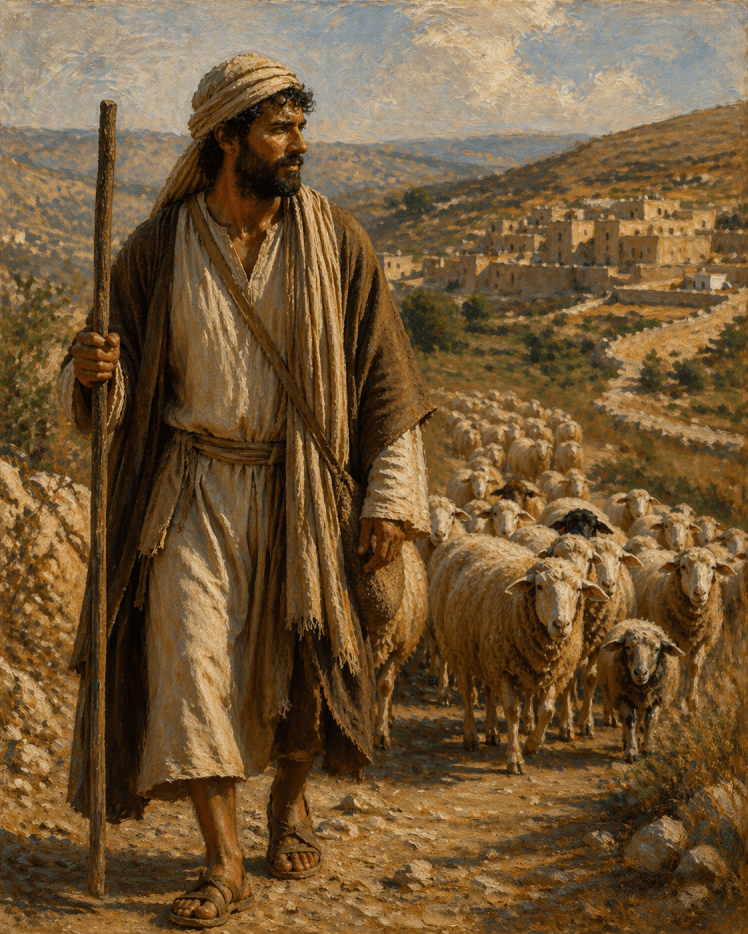
The LORD is my shepherd, I shall not want.
He makes me lie down in green pastures;
he leads me beside still waters;
he restores my soul.
He leads me in right paths
for his name’s sake.
Even though I walk through the darkest valley,
I fear no evil;
for you are with me;
your rod and your staff—
they comfort me.
You prepare a table before me
in the presence of my enemies;
you anoint my head with oil;
my cup overflows.
Surely goodness and mercy shall follow me
all the days of my life,
and I shall dwell in the house of the LORD
my whole life long. (Psalm 23 NRSV)For it is a credit to you if, being aware of God, you endure pain while suffering unjustly. If you endure when you are beaten for doing wrong, what credit is that? But if you endure when you do right and suffer for it, you have God’s approval. For to this you have been called, because Christ also suffered for you, leaving you an example, so that you should follow in his steps.
“He committed no sin, and no deceit was found in his mouth.” When he was abused, he did not return abuse; when he suffered, he did not threaten; but he entrusted himself to the one who judges justly. He himself bore our sins in his body on the cross, so that, free from sins, we might live for righteousness; by his wounds you have been healed. For you were going astray like sheep, but now you have returned to the shepherd and guardian of your souls. (1 Peter 2:19-25, NRSV)“Very truly, I tell you, anyone who does not enter the sheepfold by the gate but climbs in by another way is a thief and a bandit. The one who enters by the gate is the shepherd of the sheep. The gatekeeper opens the gate for him, and the sheep hear his voice. He calls his own sheep by name and leads them out. When he has brought out all his own, he goes ahead of them, and the sheep follow him because they know his voice. They will not follow a stranger, but they will run from him because they do not know the voice of strangers.” Jesus used this figure of speech with them, but they did not understand what he was saying to them.
So again Jesus said to them, “Very truly, I tell you, I am the gate for the sheep. All who came before me are thieves and bandits; but the sheep did not listen to them. I am the gate. Whoever enters by me will be saved, and will come in and go out and find pasture. The thief comes only to steal and kill and destroy. I came that they may have life, and have it abundantly.
“I am the good shepherd. The good shepherd lays down his life for the sheep. (John 10:1-11, NRSV)
Reflection
As we gather in the shadow of ANZAC Day — a day of remembrance, gratitude, and quiet solemnity — we remember those who served, those who suffered, and those who did not return. We honour courage, sacrifice, and endurance. Yet ANZAC Day is not only about memory; it is also about meaning. It confronts us with the deeper question of how we understand suffering, sacrifice, and the cost of laying down one’s life.
On this question, the Scriptures speak with remarkable unity. Psalm 23 portrays the Lord as a shepherd who guides and protects us, walking beside us even in the valley of the shadow of death. In 1 Peter 2 we are called to endure suffering with patience, following in the steps of Christ, “who himself bore our sins in his body on the tree.” In John 10, Jesus is revealed as the Good Shepherd who lays down his life for the sheep. Together, these passages draw us into a single theme: the Shepherd who walks with us through suffering and calls us to follow him in faithfulness.
Psalm 23 is profoundly beautiful and opens with a quiet confidence: “The Lord is my shepherd; I shall not want.” It is a deeply personal confession. The Lord is not merely a shepherd, but my shepherd.
For many who served in times of war, that image would not have been abstract. Amid the uncertainty of battle, the loneliness of distant fields, and the gnawing fear of what might come next, the longing for guidance and protection is not theoretical—it is urgent and painfully real.
What matters most is that this psalm does not promise the absence of danger. It does not say that the Lord will keep you from the valley. Instead, it declares that our Shepherd will be with us every step of the way. The lesson here is very real: we are not spared from suffering, but God is with us in it and will transform it.
This is important for how we understand both ANZAC Day and the Christian life. We do not honour those who served by pretending that suffering is easy or noble in itself. War is terrible. Loss is real. Grief does not simply disappear. Yet what Scripture offers is not denial—it is presence. God does not stand at a distance from human suffering; God steps into it.
If Psalm 23 speaks of God’s presence, then 1 Peter 2 speaks of our response. Peter writes to believers who are experiencing hardship and injustice. He does not minimise their suffering, but he reframes it.
Peter calls them—and us—to endurance. We do not suffer for doing what is right on our own, because Christ also suffered for us, leaving us an example so that we can follow in his steps. In our suffering, we look to our Shepherd for guidance and direction.
This is challenging, because we must recognise that the Christian life is not only about receiving comfort from God—it is also about walking in his path. And what is that path? It is the way of patient endurance: trusting God even when we are wronged and refusing to return evil for evil. We are reminded that, even when Jesus was reviled, he did not revile in return; when he suffered, he did not threaten but entrusted himself to the one who judges justly.
This is a different kind of courage—not the courage of the battlefield, but the courage of faithfulness. It is not the strength to defeat an enemy, but the strength to endure suffering without becoming hardened or bitter.
This, too, has something to say on ANZAC Day. While we rightly honour acts of bravery in war, we must pay attention to a deeper calling: to live lives marked by integrity, humility, and sacrificial love. The Christian is not called to glorify suffering, but to endure it in a way that reflects Christ.
In John 10, the images of shepherd and sacrifice converge. In verse 11, Jesus presents himself not merely as the one who guides the sheep, but as the Good Shepherd who lays down his life for them.
This is the turning point. The shepherd is not merely a protector—he is a sacrifice.
There is something here that resonates deeply with what we remember on ANZAC Day. We honour those who gave themselves for others—who accepted risk, hardship, and even death for the sake of their comrades and their country.
Yet Jesus’ words also lead us deeper. His sacrifice is not only an example of courage; it is the very means by which life is given. “I came that they may have life, and have it abundantly.” The cross is not simply an act of bravery—it is an act of redemption.
And this matters. Because while human sacrifice can inspire and protect, it cannot ultimately save. Even the greatest acts of courage cannot remove sin, cannot conquer death, cannot heal the deepest brokenness of the human heart.
But Christ, the Good Shepherd, does what no one else can do: he lays down his life and takes it up again. He enters into death and conquers it.
So as we remember sacrifice today, we do so in the light of a greater sacrifice—the one that gives meaning and hope beyond the grave.
Returning to Peter, he concludes with a powerful image: while we were wandering like lost sheep, Jesus gathered us in and became the guardian of our souls. We are not naturally a well-ordered flock. We do wander. We do lose our way. We become divided, fearful, and self-protective. The history of the world — and indeed the history behind ANZAC Day — bears witness to this reality.
The Shepherd not only walks with us and dies for us—he also brings us home. This has profound implications for how we remember. ANZAC Day is not simply about looking back; it is about asking what kind of people we are becoming. Are we marked by gratitude and humility? Do we seek peace rather than conflict? At the most basic level, are we a people who truly care for one another—especially the wounded, the grieving, and the forgotten?
On ANZAC Day, we stand between remembrance and hope. We remember those who walked through the valley, many with remarkable courage and self-giving love.
We honour their memory not by romanticising war, but by acknowledging its cost and giving thanks. We also look forward in hope, because the Shepherd who walked through the valley of death has come out the other side—and he leads us not into despair, but into life.
Psalm 23 ends not in the valley, but in the house of the Lord. First Peter ends not with suffering, but with restoration under the care of the Shepherd. John 10 ends not in death, but in abundant life. This is the Christian vision: not that suffering has the final word, but that God does.
The Lord is our Shepherd who has laid down his life for us. And he calls us to follow him—through valleys, through trials, and ultimately into life.
May we walk in his care, follow in his steps, and live as those who have been gathered, guarded, and given hope by the Shepherd of our souls.
©️ Robert van Oort, 2026

