
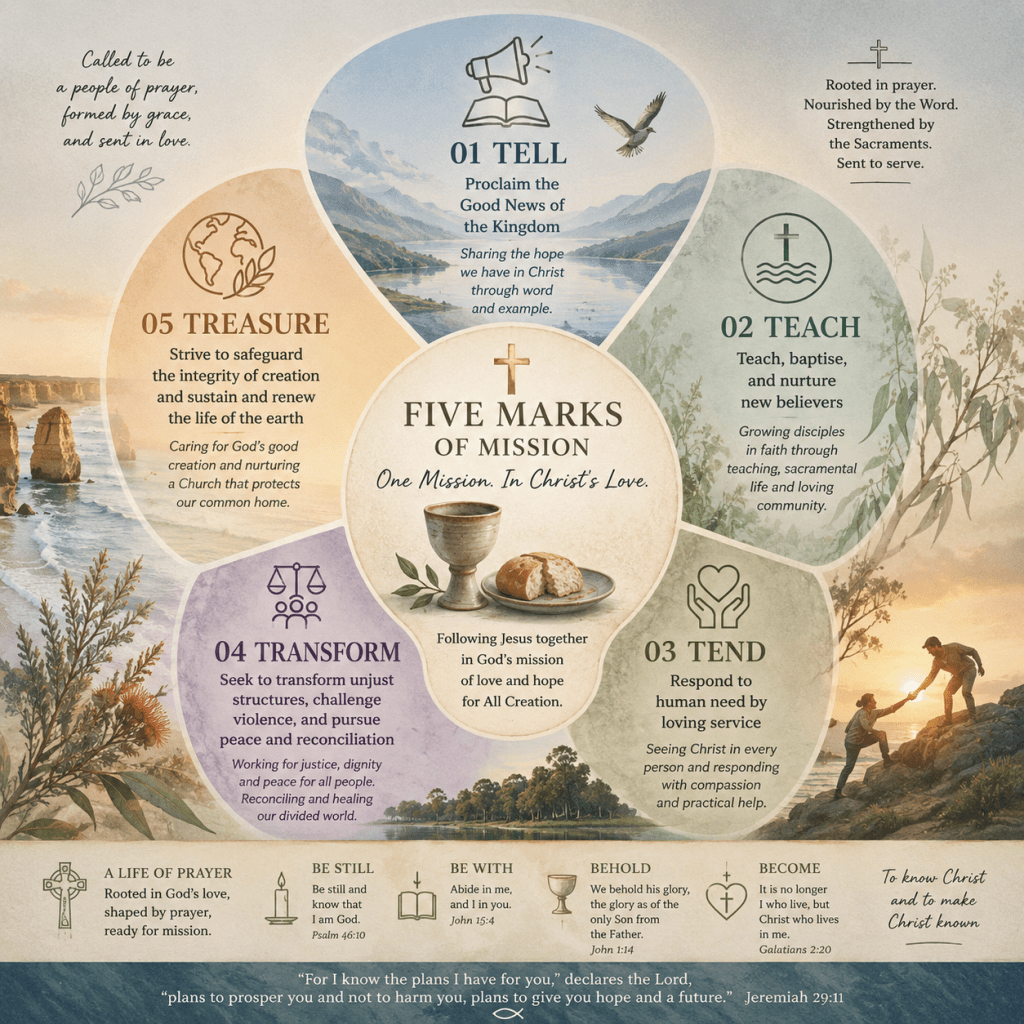
Today I invite you to reflect on five simple values that shape the Christian life: Tell, Teach, Tend, Transform, Treasure. These values arise from the Anglican Communion’s Five Marks of Mission, yet they are more than a description of what the Church does. They describe who we are called to become as followers of Jesus Christ. At the heart of these values is not a programme or a strategy, but a Person. Jesus Christ stands at the centre of all we do. As Saint Paul reminds us, “In him we live and move and have our being” (Acts 17:28). The Christian life begins and ends in Christ.
The Benedictine tradition understands this deeply. The Rule of Saint Benedict opens with a simple exhortation, “Listen carefully, my child, to the master’s instructions, and attend to them with the ear of your heart.” Before we tell, teach, tend, transform, or treasure, we must first learn to listen. Before we act, we must abide. Before we speak, we must hear God’s voice — Jesus says, “Abide in me as I abide in you” (John 15:4). Everything else flows from that relationship.
The first value is Tell
Jesus commissioned his disciples to proclaim the Good News of the Kingdom. The Church exists because generation after generation of believers shared the story of Jesus Christ. Yet Benedict reminds us that witness begins with humility. Our task is not to draw attention to ourselves, but to point people toward Christ. Sometimes we proclaim the gospel with words; often we proclaim it with our lives. Jesus said, “You are the light of the world. Let your light shine before others” (Matthew 5:14-16). People are often drawn to Christ long before they understand Christian doctrine. They encounter kindness, patience, faithfulness, and hope in a believer’s life. They see something different.
Saint Peter writes, “Always be ready to make your defence to anyone who demands from you an accounting for the hope that is in you” (1 Peter 3:15). Notice that Peter speaks of hope. Our task is not to win arguments. It is to bear witness to the hope we have found in Christ. Every act of faithful discipleship becomes a testimony. Every prayer offered, every act of forgiveness, and every quiet expression of love tells the story of Jesus.
The second value is Teach.
Jesus instructed his disciples to make disciples of all nations, baptising them and teaching them to obey all that he commanded.
Saint Benedict described the monastery as a “school for the Lord’s service.” That phrase beautifully captures the Christian life. We are lifelong learners in the school of Christ. The Christian faith is not merely inherited; it must be nurtured. We grow through Scripture, prayer, worship, fellowship, and the sacraments.
Paul reminds Timothy, “All scripture is inspired by God and is useful for teaching” (2 Timothy 3:16). The Benedictine practice of Lectio Divina offers a wonderful model. We read Scripture slowly, prayerfully, and attentively, listening for God’s voice. We allow the Word of God to shape our hearts and minds. Teaching is not merely the transfer of information. It is the formation of character. It is helping one another become more like Christ. Every Christian is called both to learn and to teach.
The third value is Tend.
Again and again in the Gospels, we see Jesus respond to human need. He heals the sick, feeds the hungry, comforts the grieving, and welcomes the outcast. One of the most beautiful teachings in the Rule of Saint Benedict is “All guests who present themselves are to be welcomed as Christ.” Imagine what our communities would look like if we truly lived that way. Every person would become a bearer of Christ’s presence.
Jesus teaches, “I was hungry and you gave me food, I was thirsty and you gave me something to drink” (Matthew 25:35). To tend is to care. It means noticing those others overlook. It means offering hospitality, compassion, and practical help. Many of the most important acts of ministry never appear in church reports: a visit to someone in hospital, a meal shared with a neighbour, a listening ear, a letter of encouragement, a prayer spoken quietly beside a bedside. These small acts of love reveal the heart of Christ.
The fourth value is Transform.
The Gospel changes individual lives and also transforms communities and societies. The prophets consistently called God’s people to justice. Jesus proclaimed good news to the poor and freedom to the oppressed. The Kingdom of God challenges anything that diminishes human dignity. Yet Benedict teaches us that transformation begins within. Before we seek to change the world, we must allow God to change us. This lifelong process of conversion, known in Benedictine spirituality as conversatio morum, is the continual conversion of life. As Christ transforms our hearts, we become agents of transformation in the world.
Jesus said, “Blessed are the peacemakers, for they will be called children of God” (Matthew 5:9). Every act of reconciliation, every stand against injustice, and every effort to build peace participates in God’s renewing work. Saint Benedict never set out to transform Europe. He simply sought to live faithfully. Yet communities rooted in prayer, stability, learning, and service became instruments through which God renewed an entire civilisation. Transformation often begins with simple faithfulness.
The fifth value is Treasure.
The opening chapters of Genesis reveal that creation is God’s gift, and humanity is entrusted with its care. The Psalmist declares, “The earth is the Lord’s and all that is in it” (Psalm 24:1). For Benedict, reverence extended to every aspect of life. He instructed that even the monastery’s tools should be treated “as sacred vessels of the altar.” This vision teaches us to approach creation with gratitude and respect.
Jesus himself pointed to creation as a teacher, saying, “Look at the birds of the air” (Matthew 6:26). The beauty of a bird in flight, the changing seasons, and the rhythm of the natural world—all proclaim the glory of God. To treasure creation is not merely an environmental concern. It is an act of worship. It is recognising the world as God’s handiwork and caring for it as faithful stewards.
These five values are not separate tasks. Together, they form a pattern of Christian discipleship. Yet they do not begin with activity, achievement, or success. They begin with prayer, listening, and abiding in Christ. We are rooted in prayer, nourished by Scripture, strengthened by the sacraments, sustained by community, and sent into the world in love. As Jesus promises, “Those who abide in me and I in them bear much fruit” (John 15:5).
May we listen with the ear of our hearts. May we tell the Good News, teach the faith, tend the needy, transform the world, and treasure God’s creation. And may all that we do be for the glory of Jesus Christ, in whom we live and move and have our being.
© Robert van Oort 2026

