
When they had finished breakfast, Jesus said to Simon Peter, “Simon son of John, do you love me more than these?” He said to him, “Yes, Lord; you know that I love you.” Jesus said to him, “Feed my lambs.” A second time he said to him, “Simon son of John, do you love me?” He said to him, “Yes, Lord; you know that I love you.” Jesus said to him, “Tend my sheep.” He said to him the third time, “Simon son of John, do you love me?” Peter felt hurt because he said to him the third time, “Do you love me?” And he said to him, “Lord, you know everything; you know that I love you.” Jesus said to him, “Feed my sheep. (John 21:15-17 NRSV)
About that time King Herod laid violent hands upon some who belonged to the church. He had James, the brother of John, killed with the sword. After he saw that it pleased the Jews, he proceeded to arrest Peter also. (This was during the festival of Unleavened Bread.) When he had seized him, he put him in prison and handed him over to four squads of soldiers to guard him, intending to bring him out to the people after the Passover. While Peter was kept in prison, the church prayed fervently to God for him.
The very night before Herod was going to bring him out, Peter, bound with two chains, was sleeping between two soldiers, while guards in front of the door were keeping watch over the prison. Suddenly an angel of the Lord appeared and a light shone in the cell. He tapped Peter on the side and woke him, saying, “Get up quickly.” And the chains fell off his wrists. The angel said to him, “Fasten your belt and put on your sandals.” He did so. Then he said to him, “Wrap your cloak around you and follow me.” Peter went out and followed him; he did not realize that what was happening with the angel’s help was real; he thought he was seeing a vision. After they had passed the first and the second guard, they came before the iron gate leading into the city. It opened for them of its own accord, and they went outside and walked along a lane, when suddenly the angel left him. Then Peter came to himself and said, “Now I am sure that the Lord has sent his angel and rescued me from the hands of Herod and from all that the Jewish people were expecting.” (Acts 12:1-11 NRSV)At my first defense no one came to my support, but all deserted me. May it not be counted against them! But the Lord stood by me and gave me strength, so that through me the message might be fully proclaimed and all the Gentiles might hear it. So I was rescued from the lion’s mouth. The Lord will rescue me from every evil attack and save me for his heavenly kingdom. To him be the glory forever and ever. Amen. (2 Timothy 4:16-18)
Reflection
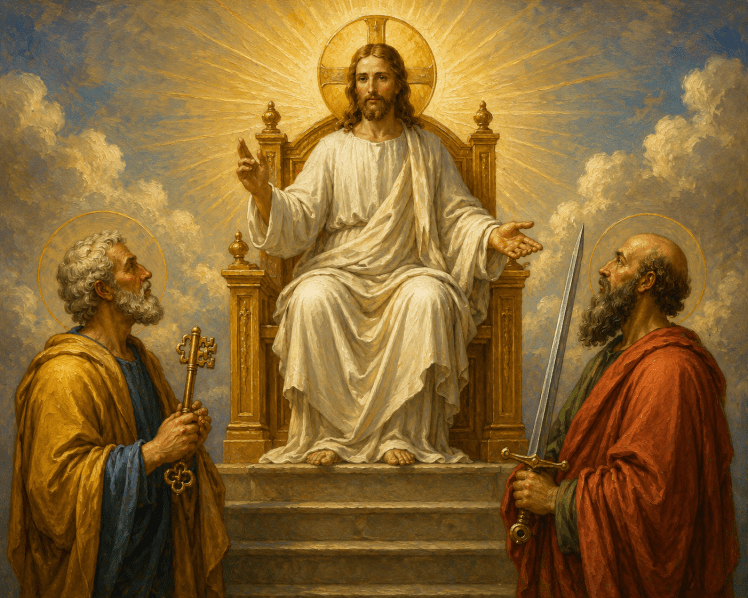
Peter and Paul are heroes of Christianity, and they are sometimes heroically depicted in church windows on either side of the risen Lord.
But have you wondered what they were really like?
There is no reliable account of Peter’s physical appearance. Yet his character emerges through his words, actions, failures, and growth. He was neither a flawless hero nor a failure. He was courageous, impulsive, devoted, outspoken, teachable, and a disciple whose weaknesses were transformed by grace. The Peter who denied Jesus became the Peter who boldly proclaimed Christ, and the fisherman who once relied on his own strength became the apostle who taught others to entrust themselves to God’s care.
What about Paul? There is an apocryphal physical description of Paul that I love. It appears in the Acts of Paul and Thecla, a Christian work probably written in the second century. It describes him as: “A man small in size, bald-headed, bow-legged, well-built, with eyebrows meeting, rather long-nosed, full of grace; for sometimes he appeared like a man, and sometimes he had the face of an angel.”
However, and more reliably, the New Testament offers a rich portrait of Paul. A man of intellectual depth, courage, zeal, humility, pastoral concern, perseverance, and deep devotion to Christ. He appears as a determined servant, transformed by grace. He was intellectually brilliant yet deeply humble, fearless yet dependent on God, and strong-willed yet pastorally tender. Above all, he was a man whose entire life was shaped by the conviction that Jesus Christ had called him, forgiven him, and entrusted him with the Gospel. As he himself wrote in 1 Corinthians: “By the grace of God I am what I am” (15:10). That sentence may be the best summary of Paul’s character and his self-understanding.
What stands out most to me in today’s readings is that God calls ordinary people who can find help and strength in Him.
That is easy to say when life is unfolding according to our plans. It is the opposite to believe when we face disappointment, failure, uncertainty, or suffering. Yet the Scriptures repeatedly show that God’s strength is revealed most clearly when human strength reaches its limits.
We see this truth in the lives of Peter and Paul. Their experiences teach us that the Lord not only calls his servants but also sustains them. He not only gives them work to do but also provides the strength to do it.
The reading from John 21 brings us to a disturbing moment in Peter’s life. He has experienced both extraordinary devotion and profound failure. He was among the first disciples called by Jesus. He witnessed miracles, walked on water, and confessed Jesus as the Christ. Yet he was also the disciple who denied his Lord three times on the night of the crucifixion. Imagine the burden Peter must have carried after the resurrection. He knew that Jesus was alive, but he also knew his own weakness. He had failed at the very moment when faithfulness mattered most.
Then comes this remarkable conversation on the shore of the Sea of Galilee. Three times Jesus asks, “Do you love me?” Three times Peter answers. And three times Jesus entrusts him with responsibility.
What is striking is that Jesus does not define Peter by his failure. He restores and recommissions him. Jesus knows Peter’s weakness better than Peter does, yet he still calls him to ministry. That is good news for all Christians.
God’s work is not entrusted to perfect people but to forgiven people. The strength required for ministry does not come from our own abilities or achievements but from the Lord himself. Peter’s future usefulness would depend not on his own courage but on God’s sustaining grace.
That lesson would be put to the test in Acts chapter 12. The Church is facing persecution. King Herod has already executed James, one of the Twelve. Seeing that this pleases his opponents, he arrests Peter as well. The situation appears hopeless. Peter is imprisoned under heavy guard. From a human perspective, there is no way out.
Indeed, Peter’s situation may seem even more desperate because he knows what has happened to James. He has every reason to believe he will soon suffer the same fate.
What follows is a powerful reminder that God’s power is not constrained by human circumstances. Peter contributes nothing to his own rescue. He does not overpower the guards, nor does he devise a clever escape. His deliverance comes entirely from God.
Acts 12 teaches us that our help ultimately comes from the Lord. Sometimes we find ourselves in situations that seem beyond our ability to resolve. We may feel trapped by illness, grief, family difficulties, financial pressures, or uncertainty about the future. We may see no clear path forward.
Peter’s imprisonment reminds us that God often works where human resources end. The Lord who opened the prison doors for Peter remains Lord today. That does not mean every prayer is answered as we desire. God’s purposes are often mysterious to us. God remains faithful, and the same Lord who governs our joys also accompanies us in our sorrows. The question is not whether we can always understand God’s ways, but whether we can trust his faithfulness.
Years later, Paul would bear witness to that faithfulness. In 2 Timothy, Paul writes from prison. Like Peter before him, he faces an uncertain future. He has endured beatings, shipwrecks, imprisonment, opposition, and abandonment. He reflects on a particularly lonely moment when he stood in his defence, and all deserted him. Even faithful servants can feel abandoned.
Paul found courage because he knew the Lord was standing beside him, giving him strength. Paul does not say the Lord removed every hardship. He does not say the Lord made life easy. He says the Lord stood beside him.
That is often how God helps us. Sometimes we hope for immediate solutions, dramatic interventions, or instant relief. Sometimes God grants those gifts. But often he gives something deeper: his presence. He stands with us, strengthens us, and enables us to continue. He gives us courage for the next step, wisdom for the next decision, and perseverance for the next day.
The Christian life is not a journey powered by our own resources. It is sustained by Christ’s presence. Peter and Paul learned this, and countless Christians throughout history have learned it in times of trial.
The Lord is our help and strength because he is with us. The same Lord who restored Peter and strengthened Paul is with us today.
Perhaps some of us identify with Peter. We are conscious of our failures and shortcomings. We wonder whether God can still use us. The answer is yes.
Perhaps some of us feel like Paul, imprisoned by circumstances we cannot change. The answer is that God is still at work, even when we cannot see the way forward.
Perhaps some of us are weary and discouraged. The answer is that the Lord stands beside us and gives us strength.
The message today is not to place our confidence in ourselves but in Christ. When we are weak, he is strong. When we are uncertain, he is faithful. When we are afraid, he is present. When we fall, he restores us. When we serve, he equips us.
Peter and Paul are examples that, no matter what lies ahead of us, the Lord is our help and our strength.
© Robert van Oort 2026

