
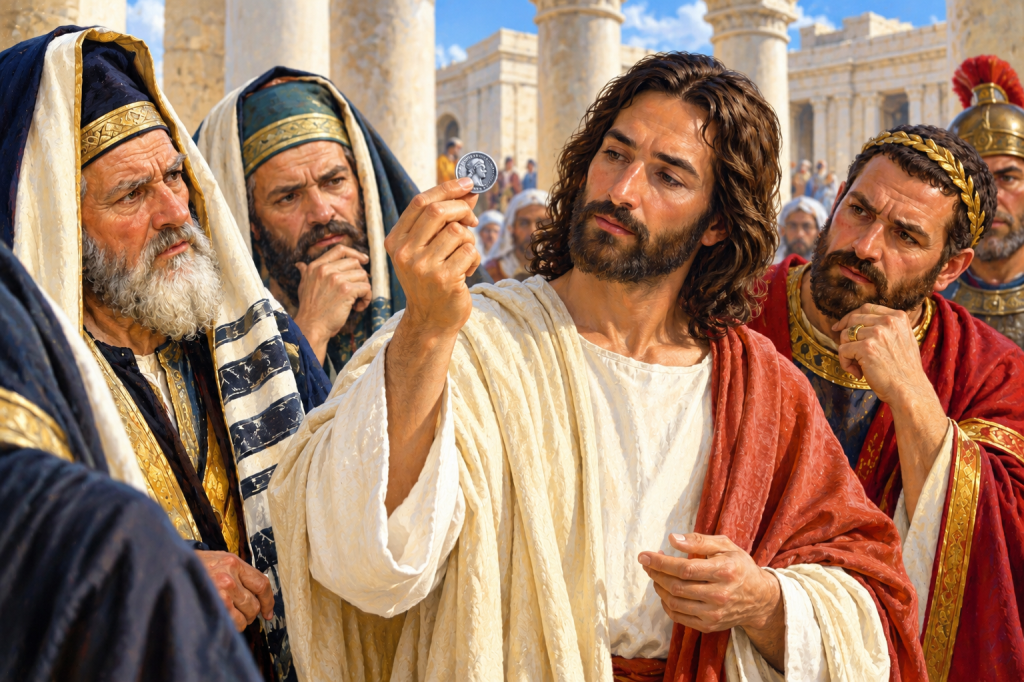
15 Then the Pharisees went and plotted to entrap him in what he said. 16 So they sent their disciples to him, along with the Herodians, saying, “Teacher, we know that you are sincere, and teach the way of God in accordance with truth, and show deference to no one, for you do not regard people with partiality. 17 Tell us, then, what you think. Is it lawful to pay taxes to Caesar or not?” 18 But Jesus, aware of their malice, said, “Why are you putting me to the test, you hypocrites? 19 Show me the coin used for the tax.” And they brought him a denarius. 20 Then he said to them, “Whose head is this and whose title?” 21 They answered, “Caesar’s.” Then he said to them, “Give therefore to Caesar the things that are Caesar’s and to God the things that are God’s.” 22 When they heard this, they were amazed, and they left him and went away. (Matthew 22:15-22 NRSVue)
As the old saying states, to apply a double standard is to judge other people on the basis of what they do and oneself on the basis of one’s intentions.
We should call someone rude if they are impatient, but if we are impatient ourselves we say that we are merely stressed. In the case of someone else breaking a promise we suspect them of not being honest, but when we break a promise ourselves we attribute it to our circumstances.
Double standards are most clearly seen in politics, where people are very good at criticising others even as they miss their own inconsistencies.
In this passage of Matthew, Jesus addresses this kind of hypocrisy. Although the question initially serves as a skilful political trick, it later becomes a profound lesson in integrity, discipleship, and what it means to belong to God. Matthew states that the Pharisees had plotted to trap Jesus by using his own words and therefore sent their disciples together with the Herodians to ask him a question.
This is the first of three questions put to Jesus in chapter twenty-two by representatives of different religious groups that put both his authority and his wisdom to the test. The question regarding taxes involved a genuine theological and ethical dilemma, namely, “Is it lawful to pay taxes to Caesar or not?” Jesus had to give an answer in a diplomatic manner since either reply might offend someone.
The reference is to the Roman poll tax, which was required to be paid by everybody in Judea under Roman rule, including slaves, and many patriotic Jews opposed it since it served to remind them that they were subject to foreign rule.
There had already been a serious revolt against Roman taxation in 6 CE under the leadership of Judas the Galilean, and his resistance contributed to inspiring the movement later associated with the Zealots, who opposed Rome and thus played a role in the Jewish revolt of 66 CE and eventually in the destruction of Jerusalem in 70 CE.
Jesus came from Galilee, a region in which the Romans did not often impose this poll tax. If he opposed the tax, his enemies could claim that he was a revolutionary. On the other hand, if he supported it, he would endanger the support of the Jews, since they saw Roman taxation as a breach of God’s authority over Israel. Their opponents thought that no matter which course he chose, they had got him into a difficulty.
The ones who ask Jesus have inconsistent standards: even though they call him truthful they at the same time plot against him, and although they acknowledge his integrity they are acting dishonestly. They require the truth yet approach him in a deceitful manner, show him respect while at the same time harbouring hostility, and say that they are looking for God’s wisdom while in fact being after political advantage. Jesus shows their hypocrisy when, in verse eighteen, he says, “Why are you putting me to the test, you hypocrites?”
He asks them to produce the coin which was used for the tax, and they bring him a denarius, a silver coin from Rome bearing the emperor’s image and the words ‘son of the divine’ or ‘son of a god’.
For devout Jews, the presence of such images violated the prohibition against idolatry and the worship of any god besides the one true God. The Romans knew about this and that is why they permitted the use of Jewish coins. Nevertheless, in this religious context, Jesus’ opponents produced a Roman coin; they rejected Roman authority whenever it was to their advantage but took part in its economy when it was beneficial to them.
It is a common difficulty that we tend to condemn systems which benefit us while at the same time criticising others for behaviour which we ourselves permit. We may want to enjoy the advantages of being in a community without always being ready to take on the responsibilities that come along with it. With regard to the Church as well, it is easy to expect people to display generosity, forgiveness, humility and a spirit of service—qualities which we often find difficult to practice ourselves.
One can show that loyalty to civil authorities need not contradict loyalty to God since it is possible both to pay taxes, carry out one’s civic responsibilities and assist the community and at the same time to be faithful. To follow Jesus is to be a responsible citizen, to strive for justice and to serve others.
Jesus drew a clear distinction between the fact that governments may properly ask for taxes and other civic obligations and the fact that they have no right to demand the ultimate loyalty which is due only to God.
This brings us to an even more basic problem: ‘the double standards of discipleship’. Even though we may take pleasure in having spotted the hypocrisy of the Pharisees and the Herodians, we are in danger of falling into the same trap. The Gospel also reveals our double standards.
We assert that each individual has been made in the image of God, but we do treat people differently according to their wealth, social status, place of origin, or beliefs. Even though we pray, ‘Forgive us our sins’, we might still be unwilling to forgive someone who has done us an injury. Although we say that we are obliged to love our neighbours, we often limit our compassion to certain people. Even though we recognise that all that we possess comes from God, we can nevertheless be very possessive of our time, our money, and our comfort. These are the double standards that Jesus urges us to examine carefully, and it is especially important to carry out such an examination as part of the Christian spiritual life.
Holiness means living in a manner that reflects our devotion to God, not merely carrying out religious duties. We must be humble, obedient and respectful. We should show our faithfulness in the things we say, in our work, in our relationships, in our responsibilities, and in the way we treat other people. The standard which applies to our Christian worship should also apply to our behaviour during the week; our prayer and our conduct should be consistent with each other.
We are called by Jesus to have one heart; this does not involve withdrawing from political or civic engagements, nor does it mean that we must accept without question all the demands made by governments. Our participation in society must always be grounded in our basic loyalty to God.
We have the obligation to be responsible citizens and to be careful and thoughtful individuals: we must show respect for legitimate authority, but at no time should we ignore injustice; we should aim at the common good while at the same time taking into account the dignity of every person. Above all, we must resist the temptation to apply a different moral standard to ourselves from that which we apply to others.
The most important question raised by this passage in Matthew on taxes is not simply ‘What do I owe Caesar?’ but ‘What do I owe God?’ The reply is not just a part of our income, a certain amount of our time, or one-time acts of worship; it is our whole life.
Because humans possess within themselves the image of God, our lives should reflect God’s character—that is to say, His justice, His mercy, His faithfulness, and His love.
Let us remember that we do not take on our Christian identity for the purpose of worship and then abandon it when we get back to everyday life. We belong to God whatever place we may be.
This might be the simplest means of eliminating double standards—by living with the same honesty, compassion, humility, and integrity that we demand from others.
Jesus said that Caesar’s image is on a coin, but God’s image is on every person. So let’s give Caesar what is his, and give God what has always been his—ourselves.
© Robert van Oort 2026

