
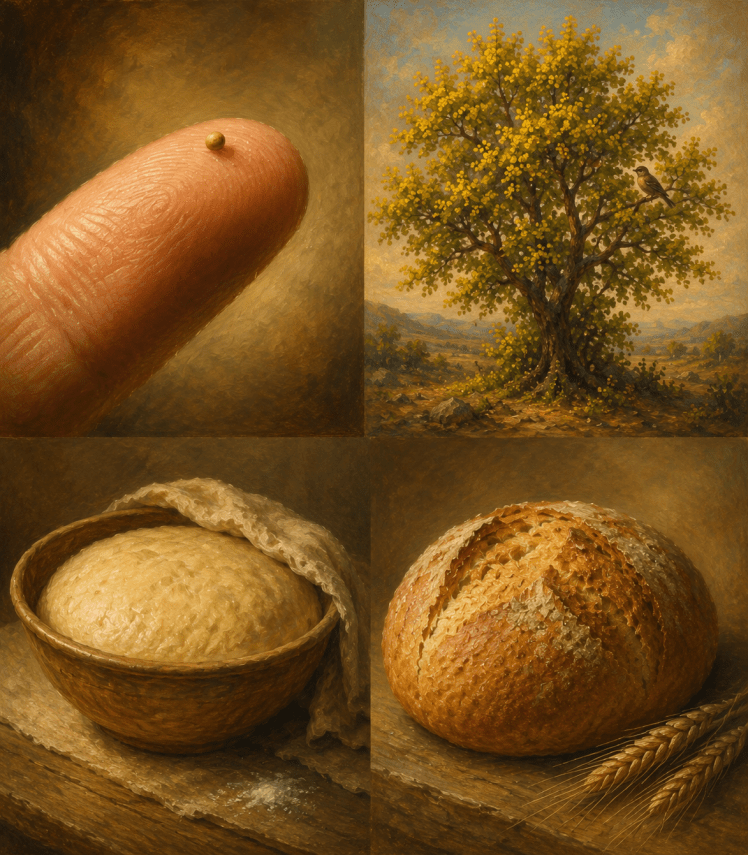
He put before them another parable: ‘The kingdom of heaven is like a mustard seed that someone took and sowed in his field; it is the smallest of all the seeds, but when it has grown it is the greatest of shrubs and becomes a tree, so that the birds of the air come and make nests in its branches.’ He told them another parable: ‘The kingdom of heaven is like yeast that a woman took and mixed in with three measures of flour until all of it was leavened.’ (Matthew 13:31–33 NRSV)
For I am convinced that neither death, nor life, nor angels, nor rulers, nor things present, nor things to come, nor powers, 39 nor height, nor depth, nor anything else in all creation, will be able to separate us from the love of God in Christ Jesus our Lord. (Romans 8:38-39 NRSV)
Life often begins with small steps and slow progress. We yearn for dramatic change, instant answers to prayers, and clear signs of spiritual growth. However, much of God’s work in us occurs quietly and almost imperceptibly. During certain seasons, our faith may feel as tiny as a mustard seed, our prayers seem feeble, and perseverance challenges us. In these moments, we might doubt whether God is still working. These scriptures remind us that God’s kingdom develops in hidden ways and his love for us remains completely secure. Jesus’ parables of the mustard seed and yeast, along with Paul’s hopeful words in Romans, encourage us to stay faithful and steadfast.
Jesus starts by likening the kingdom of heaven to a mustard seed, which is very small—about one or two millimetres—and almost insignificant in how it looks. Despite its tiny size, it grows into a tree that provides shelter for birds. The key point is not just that small things grow large, but that God’s kingdom often begins in ways that seem unimpressive to human eyes. Jesus was born in a humble village, and his disciples were ordinary—fishermen, tax collectors, and common people. His ministry seemed to end in failure on the cross, but from these modest starts, the Church was born, and the gospel was carried to the nations.
Every Christian’s journey follows a similar pattern. Genuine faith often begins quietly, sparked by a simple prayer, a Scripture verse, or the Holy Spirit’s gentle conviction. Changes may not be immediately dramatic, but God takes joy in nurturing even the smallest faith. The key is not its size but the greatness of the One in whom we trust. Just as a tiny mustard seed in rich soil contains life because God gives it, even fragile faith connected to Christ has life because Christ is our strength.
Jesus then tells the parable of the yeast hidden in flour. A woman mixes a small amount of yeast into a large quantity of dough until, eventually, the whole batch is leavened. Again, the emphasis is on quiet, hidden transformation. No one watches the yeast work moment by moment. Its activity is invisible, yet over time its effects become unmistakable.
This is often how God works within us. The path towards stronger faith is usually not dramatic but gradual. Through daily prayer, worship, Scripture, the sacraments, acts of repentance, and the fellowship of the Church, the Holy Spirit slowly reshapes our hearts. We become more patient, forgiving, and humble, and more like Christ. Sometimes others notice the change before we do. God’s transforming work is not always spectacular, but it is always effective.
These parables teach us an important lesson in perseverance. Because God’s work is often hidden, we may become discouraged. We compare ourselves with others and focus on our failures rather than on God’s promises. We imagine that because we cannot see rapid growth, nothing is happening. Yet Jesus tells us to trust in the hidden work of God’s kingdom. The seed grows. The yeast spreads. God is accomplishing his purposes even when our eyes cannot perceive them.
Paul’s words in Romans eight provide the foundation for this confidence. He declares, “For I am convinced that neither death, nor life, nor angels, nor rulers, nor things present, nor things to come, nor powers, nor height, nor depth, nor anything else in all creation, will be able to separate us from the love of God in Christ Jesus our Lord.”
Notice that Paul does not say believers will be spared suffering. In fact, throughout Romans eight, he has spoken honestly about hardship, weakness, groaning, and persecution. Christian perseverance is not based on an easy life but on an unchanging God. Our security rests not in our ability to hold tightly to Christ but in Christ’s unwavering hold on us.
This should be a source of great comfort throughout our journey of faith. There are days when our faith feels fragile. There are moments when grief overwhelms us, illness weakens us, or temptation weighs heavily upon us. Yet our salvation does not depend on the strength of our emotions. It depends on the steadfast love of God revealed in Jesus Christ. The love that called us is the love that keeps us.
Paul lists every conceivable force that might threaten our confidence: death and life, spiritual powers, present troubles, future fears, the heights of heaven and the depths below. Having exhausted every possibility, he adds, “nor anything else in all creation.” There is simply nothing capable of breaking the bond established by God’s grace in Christ. This is not because Christians are strong, but because Christ’s love is stronger than every opposing power.
Here the two readings beautifully complement one another. Jesus teaches that God’s kingdom grows quietly and steadily. Paul assures us that nothing can stop God’s saving purpose. Together they remind us that perseverance is not merely human determination. Christian perseverance is sustained by divine faithfulness.
This truth has sustained countless people throughout history. Many of the greatest Christian saints lived lives that seemed outwardly ordinary. They were not famous preachers or great theologians. They simply remained faithful. They prayed, worshipped, and served their neighbours. They endured suffering without losing hope. Looking back, we can see that God used their quiet faithfulness to bless families, churches, and entire communities. Like mustard seeds, their lives grew into something far greater than they had imagined.
Perhaps that is exactly what we need to hear today. There are times when we may feel our faith is small. We may wonder whether our prayers accomplish anything. We may feel weary of continuing to follow Christ day after day. When that’s the case, remember the mustard seed and the yeast. God’s work is often hidden before it becomes visible. He is at work even now, shaping us into the likeness of his Son.
Similarly, during moments of sorrow, uncertainty, or fear, recall Paul’s powerful reassurance: while our circumstances may shift—our health deteriorates, plans fall apart, relationships disappoint, or even death approaches—nothing can separate us from God’s love in Christ Jesus our Lord, which remains constant.
Therefore, the message is to continue in faith. Continue in prayer even when answers seem delayed. Continue reading the Scriptures even when understanding comes slowly. Continue gathering with God’s people even when our hearts feel weary. Continue serving Christ in the ordinary tasks of daily life. The kingdom grows one faithful act at a time, often unnoticed, yet always under God’s sovereign care.
As we persevere, we do so with hope rather than anxiety. The God who planted the seed will bring it to maturity. The God who mixed the yeast into the dough will complete his work. The God who loved us enough to send his Son will never abandon those who belong to him.
In this broken and divided world, now is the time for confidence. Our faith may sometimes be small, but our Saviour is infinitely great. Our progress may seem slow, but God’s kingdom is advancing. Our trials may be many, but God’s love is unbreakable. Therefore let us persevere in faith, trusting that the God who began a good work in us will surely bring it to completion, until the day when faith becomes visible, and we rejoice forever in the presence of the Lord whose love can never fail.
© Robert van Oort 2026

