
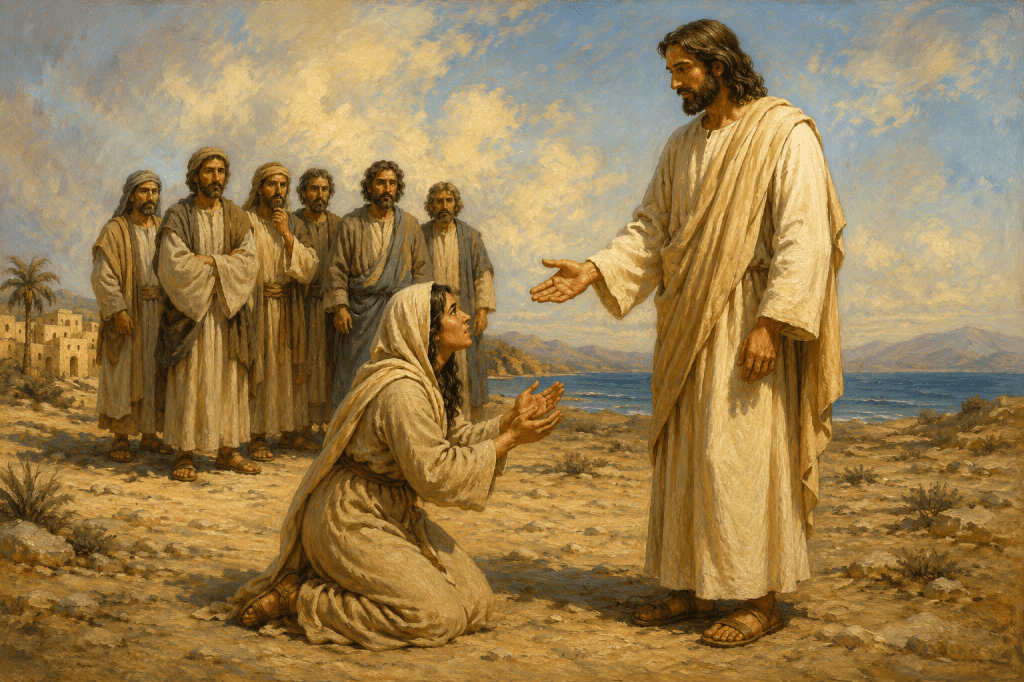
Jesus left that place and went away to the district of Tyre and Sidon. Just then a Canaanite woman from that region came out and started shouting, “Have mercy on me, Lord, Son of David; my daughter is tormented by a demon.” But he did not answer her at all. And his disciples came and urged him, saying, “Send her away, for she keeps shouting after us.” He answered, “I was sent only to the lost sheep of the house of Israel.” But she came and knelt before him, saying, “Lord, help me.” He answered, “It is not fair to take the children’s food and throw it to the dogs.” She said, “Yes, Lord, yet even the dogs eat the crumbs that fall from their masters’ table.” Then Jesus answered her, “Woman, great is your faith! Let it be done for you as you wish.” And her daughter was healed instantly. (Matthew 15:21-28 NRSV)
Some passages of Scripture confront us. They can be deeply complex and troubling for the modern reader in the twenty-first century. This extract from Matthew’s Gospel is one of the difficult passages and deserves closer scrutiny.
We read in Matthew that Jesus has withdrawn into the Gentile region of Tyre and Sidon. There he is approached by a Canaanite woman who cries, “Have mercy on me, Lord, Son of David; a demon torments my daughter.”
Matthew deliberately calls her a Canaanite. By the first century, this was an ancient designation. It evokes the long biblical history of Israel and the peoples of Canaan. She is therefore presented to us as an outsider—not merely geographically, but in Israel’s covenant history. Yet this outsider addresses Jesus with remarkable insight: “Lord, Son of David.” She recognises something about Jesus that many in Israel have failed to recognise.
And Jesus answers her in silence. The disciples grow irritated and urge him to send her away. Then Jesus responds, “I was sent only to the lost sheep of the house of Israel.”
This brings us to the heart of the passage.
Jesus does not appear in history without context. He is the Messiah whose ministry fulfils the promises God made to Abraham. God chose Israel and entered into covenant with them, so that through them the purposes of God might ultimately embrace the world. God’s promise to Abraham was, “In you all the families of the earth shall be blessed” (Genesis 12:3). Israel’s election, therefore, was never intended simply as a privilege. Election was a vocation. Israel was chosen for the sake of God’s larger purpose.
That is important because it explains why Jesus says, “I was sent only to the lost sheep of the house of Israel.” Earlier in this Gospel, Jesus had instructed the Twelve to go first to “the lost sheep of the house of Israel” (Matthew 10:6).
But the question the Canaanite woman raises is this: How far will the blessings of that covenant extend?
Beneath the conversation lies a difficult social history. Tyre was prosperous, yet it relied on Galilee for agricultural produce. During shortages, wealthy Tyreans could buy grain that poorer Galileans desperately needed. Acts 12:20 records Tyre and Sidon’s dependence on the surrounding region for food, and the historian Josephus describes considerable hostility between the Tyrians and the Jews.
When Jesus speaks about bread, children and dogs, these are not entirely abstract images. Bread had social, economic and historical significance. The words remain uncomfortable for us because we read them in a context different from that of the first century.
Various explanations have sought to soften them. Perhaps “dogs” was common terminology for Gentiles. Perhaps Jesus is testing the woman. Perhaps he is voicing the attitudes of his contemporaries to overturn them. There may be truth in some of these explanations. Yet we should not explain away the tension too quickly, for Matthew seems to want us to feel it.
What’s left hanging after the encounter is the question that would later confront the early Church: Can the Gentile share in Israel’s salvation?
The woman kneels before Jesus and says, “Lord, help me.” It is one of the simplest yet most profound prayers in Scripture. She does not argue for her worthiness. She does not claim membership of Israel. She does not demand a right. She appeals to mercy.
And when Jesus speaks of the children’s bread, she responds, “Yes, Lord, even the dogs eat the crumbs that fall from their masters’ table.”
Notice what she does not say. She does not ask Jesus to deny Israel’s covenant. She accepts the image of Israel receiving the bread. But she perceives something deeper about God’s nature. There is enough grace at God’s table for others as well. Grace is not diminished by being shared. Mercy is not exhausted by being given. The abundance of God cannot finally be contained within the boundaries human beings draw around it.
Jesus responds, “Woman, great is your faith! Let it be done for you as you wish.”
Her daughter is healed. This is not the abolition of Israel’s covenant. Rather, it anticipates the fulfilment of God’s ancient purpose, that the nations should receive blessing through Israel. What appears here as a glimpse becomes, after Easter, the Church’s mission.
This passage therefore confronts us with a profound truth. No one is beyond the reach of God’s love and compassion. That does not mean everything we do is equally good, nor that Christian faith lacks moral content. Grace does not abolish truth, repentance or discipleship. But it does mean that Christians are never authorised to decide that another human being lies beyond the possibility of God’s mercy.
Relationships with those outside our familiar circle can work on us like sandpaper on rough wood. They expose impatience, prejudice and self-sufficiency. Through them, God may smooth the rough edges of our discipleship and make us more useful for his kingdom. This matters greatly in our polarised society. Political disagreement, economic difference, ethnicity, religion and culture can easily become reasons for demonising others.
The Church should embody something different. The Christian community should demonstrate that people who disagree profoundly can nevertheless recognise one another as persons created in the image of God, persons for whom Christ died, and persons whom we are commanded to love.
The doors of the Church must remain wide open. After all, how else did any of us enter?
But there is one final dimension to this story. The Canaanite woman’s plea is prayer, and her experience mirrors something many Christians know. She prays — and encounters silence. She persists — and encounters resistance. She kneels and prays again, “Lord, help me.” There is something deeply biblical about such persistence.
Christian prayer is therefore not simply asking God for something and expecting an immediate answer. Prayer is also perseverance in relationship with God. Persistence does not manipulate God. Nor does faith mean that God must give us whatever we request. Rather, persistent prayer expresses the conviction that even when God seems silent, God remains God, and God remains merciful.
The woman does not understand Jesus’ silence. But she knows enough about Jesus to remain before him. That is faith. And perhaps faith is not always having answers. Sometimes faith is refusing to walk away from Christ when we do not have them.
The Canaanite woman remains, trusts and persists. And Jesus says, “Great is your faith.”
So this difficult Gospel finally leads us to great truths. God is faithful to his covenant, yet God’s saving purpose reaches out to embrace the nations. The boundaries of ethnicity, status, politics, culture, or human prejudice cannot confine God’s grace. And faith perseveres — even in silence — because it trusts in the inexhaustible mercy of God.
May we become visible signs of the wideness of God’s mercy. And when God seems silent, may we have the faith of this remarkable woman to remain before Christ, to continue knocking at the door of grace, and to pray, “Lord, help me.”
God revealed in Jesus Christ mercy that is greater than the boundaries we construct, whose grace is more abundant than we imagine, and whose table has room enough for the whole world.
“Woman, great is your faith.” May Christ find such faith in us.
© Robert van Oort 2026

